Political influence is easy to allege and difficult to prove.
A campaign can spend millions of dollars. A lobbying organisation can meet senior politicians. A foreign government can secure repeated access. A politician can vote in the direction that an organisation wanted.
All of those things matter.
But none of them, on its own, answers the harder question: did the intervention change the decision?
TWIS spent months testing that distinction across Israel-related politics in the United States and United Kingdom. We mapped advocacy organisations, electoral spending, government-to-government links, defence relationships and policy episodes. We then compared those cases with matched episodes involving Saudi Arabia, the United Arab Emirates, Qatar and Taiwan.
The result is neither “there is no influence” nor “Israel controls Western policy”.
The evidence supports something narrower and more useful.
Israel-linked organisations and Israeli state actors have substantial access to US and UK political systems. They lobby, spend, mobilise supporters, make requests and sometimes obtain outcomes they favour. In some bounded state-to-state episodes, a causal contribution can be demonstrated directly. But repeated access, spending and policy alignment do not by themselves establish that a non-state organisation produced the policy outcome.
That distinction survives the strongest counterexamples we found.
What we found
The final evidence graph supports six core findings.
First, the political intervention is real. AIPAC-linked electoral activity, CUFI mobilisation, UK advocacy organisations, defence-industry interests and Israeli state diplomacy are all documented.
Second, some Israeli-state contributions can be demonstrated. Where an official record connects an Israeli request or bilateral process to a US or UK governmental response, the evidence can clear the causal threshold.
Third, the non-state causal bridge is much harder to establish. In the selected UK core cases, none of the 11 contains a complete independently evidenced chain from a non-state advocacy intervention through attributable behavioural change to the final UK policy outcome.
Fourth, failed and contrary outcomes matter. Governments sometimes resisted, reversed, limited or rejected positions supported by organisations with access.
Fifth, the comparator cases show that access, state bargaining, policy alignment, success and failure are not unique to Israel-related politics. Five of 12 matched comparator episodes contained bounded established contributions; seven remained not demonstrated.
Sixth, the combined evidence does not establish policy purchase, automatic compliance, a unified command structure or general Israeli control over US or UK foreign policy.
That last finding should not be inverted. It does not establish the absence of influence.
The test: where does the evidence chain reach?
We used the same causal sequence throughout the investigation:
connection → access → intervention → transmission → behavioural or process effect → policy outcome
Each step means something different.
A connection means actors are linked.
Access means an actor can reach the policymaker or institution.
An intervention means the actor seeks a specific outcome.
Transmission means the request, information or pressure reaches the relevant decision process.
A behavioural or process effect means something observable changes because of that intervention.
Only then can the analysis ask whether the intervention contributed to the policy outcome.
Most arguments about lobbying skip several of these steps. They move from “they met” or “they donated” to “they caused the decision”.
Our evidence model does not permit that jump.
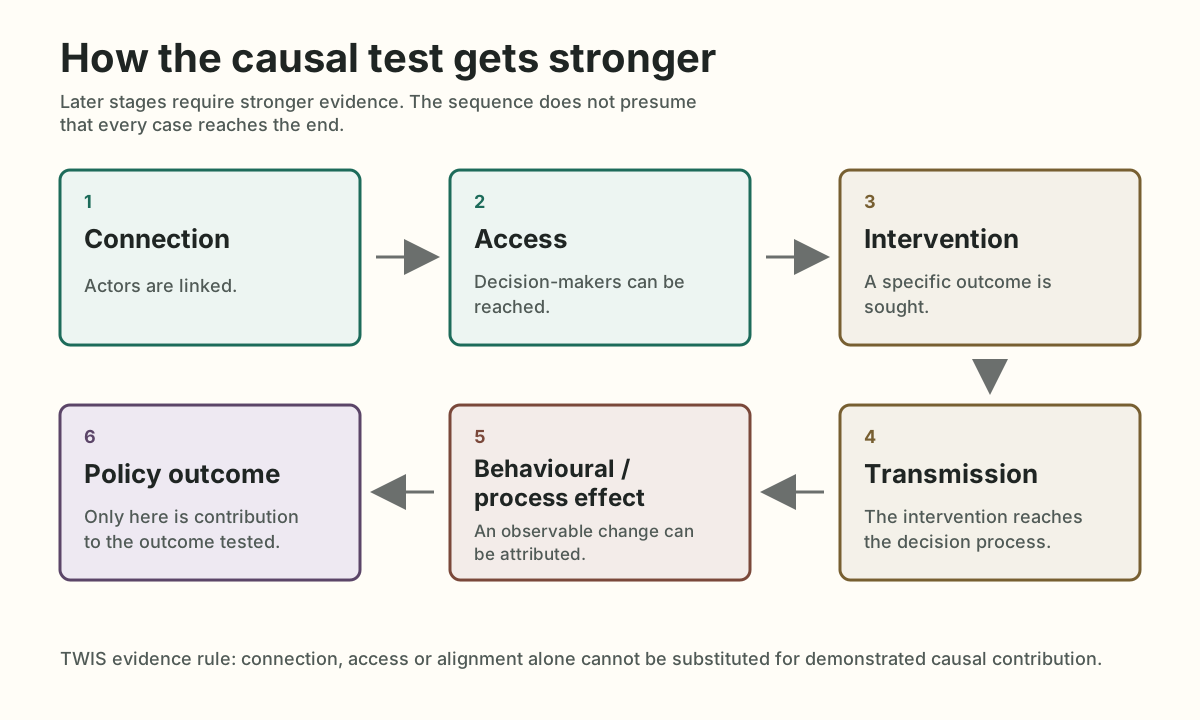
Graphic 1. The causal chain is an evidence ladder, not a presumption that every case reaches a policy effect.
AIPAC and United Democracy Project: electoral power is visible
The electoral intervention around AIPAC is among the clearest parts of the US evidence.
United Democracy Project, an AIPAC-linked super PAC, is registered with the Federal Election Commission as an independent-expenditure-only committee. For the period from 1 January 2025 to 31 July 2026, the FEC records $50.9 million in independent expenditures, within $77.2 million in total disbursements.
The FEC describes independent expenditure as spending in support of or opposition to candidates in which the money is not directly given to or spent by the candidate.
That is significant political activity.
The evidence also establishes that candidates and races are selected for support or opposition and that the organisation seeks electoral outcomes.
What it does not automatically establish is the next proposition: that spending changed the later policy preferences of the candidate.
That requires a different evidentiary chain.
A politician may already hold the preferred position. Electoral support may help keep an aligned politician in office without changing that politician’s beliefs. A later vote may align with the spender’s preference for reasons that existed before the spending.
The frozen AIPAC/UDP conclusion is therefore deliberately narrow:
Electoral targeting and intervention are established. Purchase or production of policy outcomes is not demonstrated.
That is not a defence of the spending. It is a statement about what the evidence can prove.
CUFI: mass mobilisation, lobbying and access
Christians United for Israel presents a different mechanism.
CUFI describes a national grassroots organisation with millions of supporters and records campaigns involving large volumes of messages to elected officials. Its own material says members sent more than one million emails during the Taylor Force Act campaign and more than 135,000 messages to the White House concerning the Jerusalem embassy.
Those records establish mobilisation.
They also show something important about source handling. CUFI describes several policies as achievements of its campaigning. That is relevant evidence of what CUFI claims it did.
It is not independent proof that CUFI was the pivotal cause.
To reach that conclusion, the investigation would need evidence tying CUFI’s intervention to an identifiable decision-maker change or policy-process effect while controlling for prior political commitments, parallel pressure and other pathways.
That bridge was not established strongly enough in the investigated cases.
The final CUFI finding is therefore:
Mobilisation, lobbying and high-level access are established. Purchase, control or independent production of the investigated US policy outcomes is not demonstrated.
The Israeli state is a different actor
One of the most important corrections in this investigation was refusing to treat the Israeli government, AIPAC, CUFI and other advocacy organisations as one interchangeable causal actor.
They are not.
State-to-state diplomacy can leave a much clearer evidentiary trail than lobbying.
In August 2014, for example, the Obama White House signed legislation providing $225 million in emergency Iron Dome funding. The White House statement explicitly referred back to the administration’s support for Israel’s request for that additional funding.
That supplies the bridge that is missing in many lobbying cases:
request → documented governmental response → funded policy outcome
The finding is bounded. Israel did not act alone: the President and Congress had their own security, alliance and domestic political reasons for approving the money.
But the Israeli request can still be identified as a documented contribution to that particular decision.
A similar distinction appears in the 2020 qualitative military edge episode. The Israeli government’s own statement describes an agreement following an extended dialogue between the Israeli Ministry of Defence and the Pentagon.
Again, that is stronger evidence for a state-to-state pathway than the mere existence of access.
The correct conclusion is therefore not that Israeli state influence is absent.
It is that specific Israeli-state causal contributions can be demonstrated in bounded episodes without establishing general Israeli control over US policy.
Defence industry: money can explain incentives without proving a decision
The defence and security industry adds another layer.
US military assistance to Israel can lead to procurement. Procurement can produce commercial benefit for defence contractors. Contractors lobby government and have strong interests in procurement and security policy.
Those connections are real.
But a commercial beneficiary is not automatically the cause of the policy that benefits it.
The defence tranche therefore established the assistance-to-procurement-to-commercial-benefit pathway and evidence of industrial lobbying and reinforcement.
It did not establish that a particular contractor independently caused the investigated foreign-policy decisions.
This is a recurring lesson in the graph:
an incentive is not yet an attribution.
The UK gives us a different test
The UK case set is useful because it contains both close bilateral cooperation with Israel and substantial policy disagreement.
The strongest state-to-state example is the 2030 Roadmap for UK-Israel bilateral relations.
The Roadmap is not inferred from lobbying contacts. It is a signed bilateral instrument. The UK and Israeli governments explicitly describe the document as building on their 2021 strategic partnership and setting out joint cooperation through 2030.
That is policy co-production in the ordinary meaning of the term.
It does not follow that CFI, LFI or another non-state organisation caused the Roadmap.
That claim would require its own evidence.
Eleven UK cases, one repeated missing link
The core UK investigation examined 11 selected policy episodes.
They included:
- the 2030 Roadmap;
- anti-boycott legislation;
- the Jerusalem embassy review;
- the pause and restoration of UNRWA funding;
- Gaza ceasefire and UN Security Council voting;
- the ICC jurisdiction dispute;
- arms-export licensing;
- West Bank sanctions;
- suspension of upgraded free-trade negotiations;
- recognition of Palestine;
- and settlement-related trade measures.
The repeated pattern was striking.
Advocacy and access could often be demonstrated.
The attribution bridge usually could not.
Across the 11 cases, none established a complete independently evidenced causal chain from a non-state advocacy organisation to the final UK policy outcome.
That is a statement about this selected corpus. It is not an estimate of all British foreign policy and it does not mean no advocacy ever mattered.
Why prior positions change the picture
The anti-boycott Bill illustrates why chronology matters.
CFI and LFI both intervened in the parliamentary process. They did not take identical positions: both opposed BDS, but LFI raised significant objections to the Bill’s design.
More importantly for causation, the government’s objective did not begin with those 2023 submissions.
The policy had a 2019 Conservative manifesto baseline.
That makes later advocacy relevant to the legislative process but weakens any claim that the advocacy produced the underlying policy objective.
The Bill also failed to become law when the parliamentary session ended.
A serious causal analysis has to keep both facts.
The UK also acts against some advocacy preferences
The UK record includes clear examples of governmental action that ran against positions taken by organisations with established access.
On 2 September 2024, the government suspended around 30 arms-export licences for items assessed as potentially usable in military operations in Gaza after a formal review concluded there was a clear risk that certain exports might be used in serious violations of international humanitarian law.
The strongest public mechanism in that episode is therefore the export-control review.
Advocacy for broader restrictions existed. That does not establish that a particular organisation produced the decision.
On 20 May 2025, the Foreign Secretary suspended negotiations on an upgraded UK-Israel free-trade agreement. His statement explicitly said the Israeli government’s actions had made the step necessary and that the conduct of the war in Gaza was damaging the relationship.
Different advocacy organisations took different positions on that move.
On 21 September 2025, the UK formally recognised Palestine. The Prime Minister explicitly connected the decision to Labour’s manifesto, the conditions he had set out in July, the worsening situation in Gaza and the government’s wider two-state strategy.
Some Israel-related advocacy organisations supported that direction. Others opposed recognition at that point.
Those disagreements matter because they contradict the idea of a single coherent non-state network whose preferences automatically become British policy.
What the UK evidence actually supports
The UK evidence supports a model in which several mechanisms operate at once:
- bilateral state diplomacy;
- non-state lobbying and public advocacy;
- prior party commitments;
- legal review;
- parliamentary pressure;
- government turnover;
- sanctions criteria;
- humanitarian evidence;
- alliance and diplomatic considerations;
- and external events.
Sometimes those mechanisms reinforce each other.
Sometimes they conflict.
That is why “access” is too weak a concept to carry a claim of control.
Why compare Israel-related cases with other foreign networks?
A pattern can look distinctive when there is no control group.
Foreign governments lobby. They negotiate. They cultivate political relationships. They build security partnerships. They invest. They request arms sales and diplomatic treatment.
So we constructed a matched comparison using Saudi Arabia, the United Arab Emirates, Qatar and Taiwan.
The purpose was not to claim these countries or their political networks are identical to Israel-related actors.
They are not.
The comparison asks a narrower question:
Do the mechanisms often presented as evidence of exceptional Israel-linked influence also appear in other foreign-policy relationships?
The answer is yes.
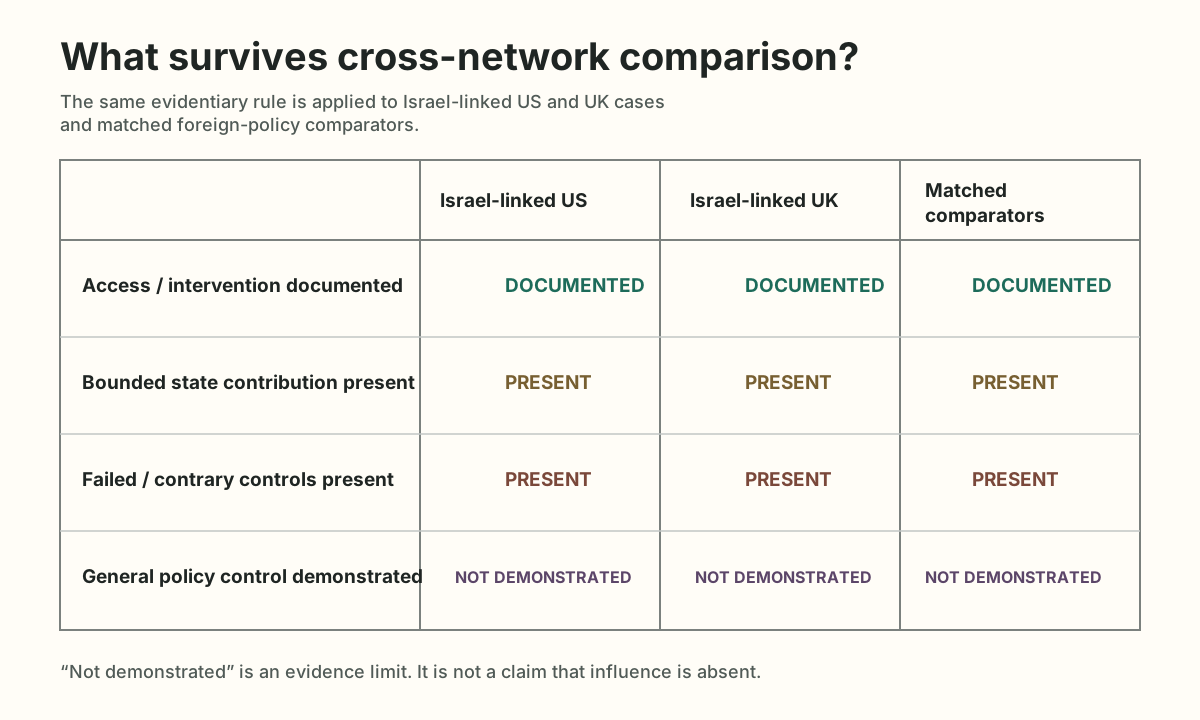
Graphic 2. Comparison changes the standard of proof: access and successful alignment are not enough on their own to establish general policy control.
What the 12 comparator episodes found
The comparator corpus contained 12 core policy episodes.
Five produced bounded ESTABLISHED causal contributions.
Seven remained NOT_DEMONSTRATED.
The stronger positive cases shared an important feature: the attribution bridge was visible.
The UAE-UK Sovereign Investment Partnership, for example, is a formally agreed investment framework overseen by the UK Office for Investment and Abu Dhabi’s Mubadala. The UAE committed £10 billion through that partnership.
The US-Qatar Major Non-NATO Ally relationship was publicly connected by US officials to Qatar’s contributions to US security objectives, including its role in the Afghanistan evacuation.
The UK-Qatar defence relationship includes a formally joint Typhoon squadron and training arrangements built through agreements between the two countries.
Those are examples of genuine foreign-state contribution.
They are not examples of hidden control.
Negative controls matter as much as successful cases
The comparator cases also contain resistance.
In 2019, Congress passed a Yemen War Powers resolution intended to end unauthorised US military involvement in the Saudi-led war. President Donald Trump vetoed it. The Senate then failed to override the veto.
That episode contains competing institutions, competing policy preferences and a contested outcome.
Taiwan provides another useful control. It was not included in the original Indo-Pacific Economic Framework launch in May 2022. The United States and Taiwan launched a separate 21st-Century Trade Initiative days later.
The later alternative does not erase the fact that the first preferred route was unavailable.
Across the comparator corpus we found failure, delay, restriction, conditionality and contrary governmental behaviour alongside successful and jointly produced outcomes.
That matters because a theory of “control” has to explain failures as well as successes.
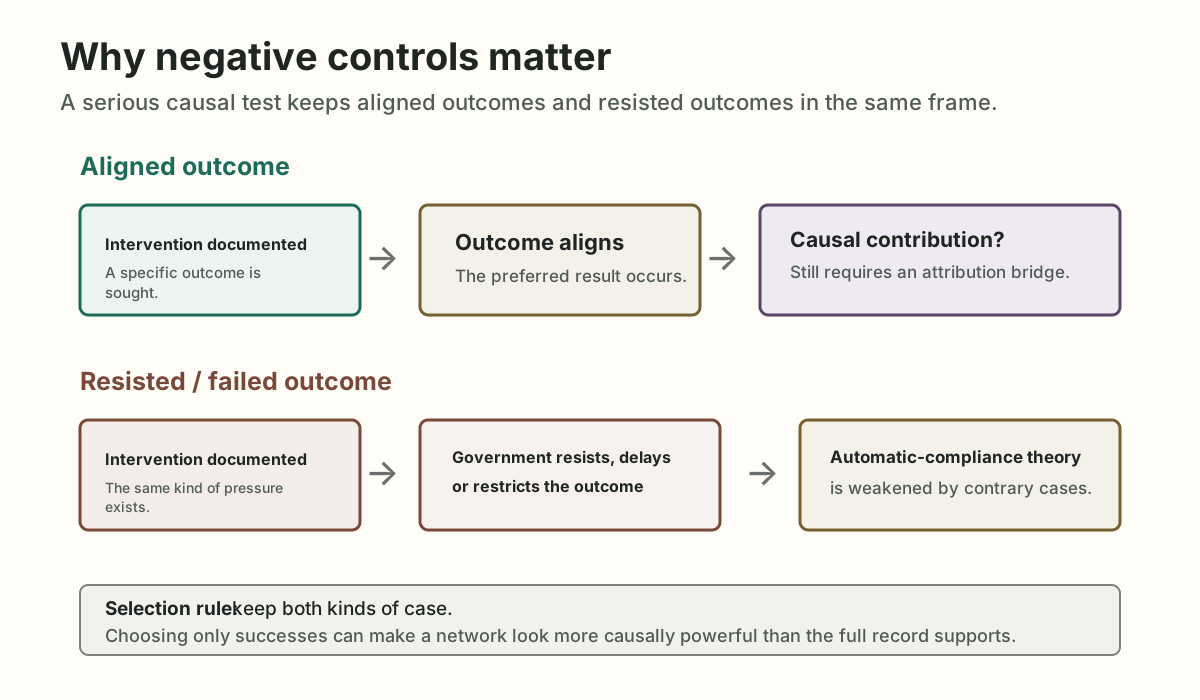
Graphic 3. A network cannot be judged only by the cases in which the preferred outcome occurred.
The comparison changes what counts as evidence
After comparison, several propositions become much harder to sustain.
Foreign access is not distinctive.
State-to-state bargaining is not distinctive.
Economic and defence interests are not distinctive.
Successful policy alignment is not distinctive.
Government resistance is not distinctive either.
The thing that separates stronger causal cases from weaker ones is not the identity of the foreign actor.
It is the evidence connecting intervention to decision.
What the investigation does not establish
The complete graph does not establish:
- that AIPAC or UDP purchases congressional policy;
- that CUFI independently produces US policy decisions;
- that defence contractors determine US Israel policy;
- that CFI, LFI, Yachad, CAABU, MAP or another investigated UK advocacy organisation controls British policy;
- that Israel-related organisations form one unified command structure;
- that political donations, independent expenditures, meetings or funded activity create a quid pro quo;
- that US or UK governments automatically comply with Israeli preferences;
- or that Israel generally controls US or UK foreign policy.
Several of those propositions are contradicted by negative controls. Others simply lack the required causal bridge.
What it also does not establish
The investigation does not establish that Israeli or advocacy influence is absent.
A public evidence graph has limits.
Important effects can occur in private conversations. Policymakers can internalise arguments over time. Access can shape agendas in ways that do not produce a neat documentary trail.
Those possibilities matter.
But an unobserved influence cannot be used as evidence that the influence occurred.
Where the causal bridge is absent, the disciplined finding is:
NOT DEMONSTRATED.
That is different from both “false” and “secretly true”.
The strongest overall finding
The evidence is most consistent with a multi-causal policy system.
External actors can lobby, negotiate, mobilise supporters, provide information, make requests, create incentives and sometimes make an identifiable contribution to government decisions.
Those interventions operate alongside:
- pre-existing politician preferences;
- party commitments;
- elections;
- domestic advocacy;
- legislation and courts;
- bureaucratic processes;
- alliance structures;
- security concerns;
- commercial interests;
- government turnover;
- wars and crises;
- and public opinion.
An outcome may result from several of those pathways at once.
That makes causal claims harder.
It also makes them more meaningful when the evidence actually supports them.
The central conclusion
The frozen graph-wide conclusion is:
The evidence supports substantial access, advocacy, electoral intervention, mobilisation, bilateral cooperation and some bounded causal contributions, but does not establish purchased policy, automatic governmental compliance, lobbying pivotality or general Israeli control of US or UK foreign policy.
The Israel-Western Influence Evidence Graph establishes substantial and repeated Israel-related advocacy, electoral intervention, institutional access, bilateral diplomacy, defence relationships and political alignment in the United States and United Kingdom.
It also establishes specific bounded Israeli-state causal contributions where documentary evidence connects a request, action or bilateral process to a Western governmental response.
For the investigated non-state advocacy organisations, however, the evidence usually stops earlier.
Spending, lobbying, meetings, sponsored activity, ideological alignment and favourable policy outcomes are documented. They do not by themselves establish that the organisation changed the relevant decision-maker’s behaviour or produced the policy outcome.
The matched foreign-policy comparison reaches the same methodological result.
Access is real.
Influence can be real.
Specific contribution can sometimes be demonstrated.
Control requires much more evidence.
In this investigation, that evidence was not found.
The conclusion should therefore remain bounded:
Israel-linked state and non-state actors operate within, and sometimes contribute to, multi-causal US and UK policy systems. Specific contribution can be demonstrated when the attribution bridge exists. Where that bridge is absent, causal contribution remains not demonstrated.
That is less dramatic than a theory of total control or total independence.
It is also what the evidence supports.
Methods and case tables
The public evidence annex shows the causal-stage definitions, the selected UK case table, the 12 comparator results, evidence labels and the aggregation boundary used for the final synthesis.